鹿鼎记陈小春版
Chinese team develops intelligent vision sensor that turns light signals into AI-ready tokens, reducing use of energy_我的网站

A | 日前,“中国体育彩票”东莞市第九届市民运动会暨2026时尚运动节乒乓球比赛在东莞市乒乓球训练基地圆满落下帷幕。经过两天的激烈角逐,54支队伍、近300名选手以球会友,在银球翻飞间点燃了全民健身热情。本届赛事设镇街组与公开组两大组别,覆盖全市24个镇街(园区)代表队及30支来自企业、校园、俱乐部等多元主体的公开组队伍。赛事采用混合团体赛制,通过“小组单循环+单淘汰”赛制决出最终名次。
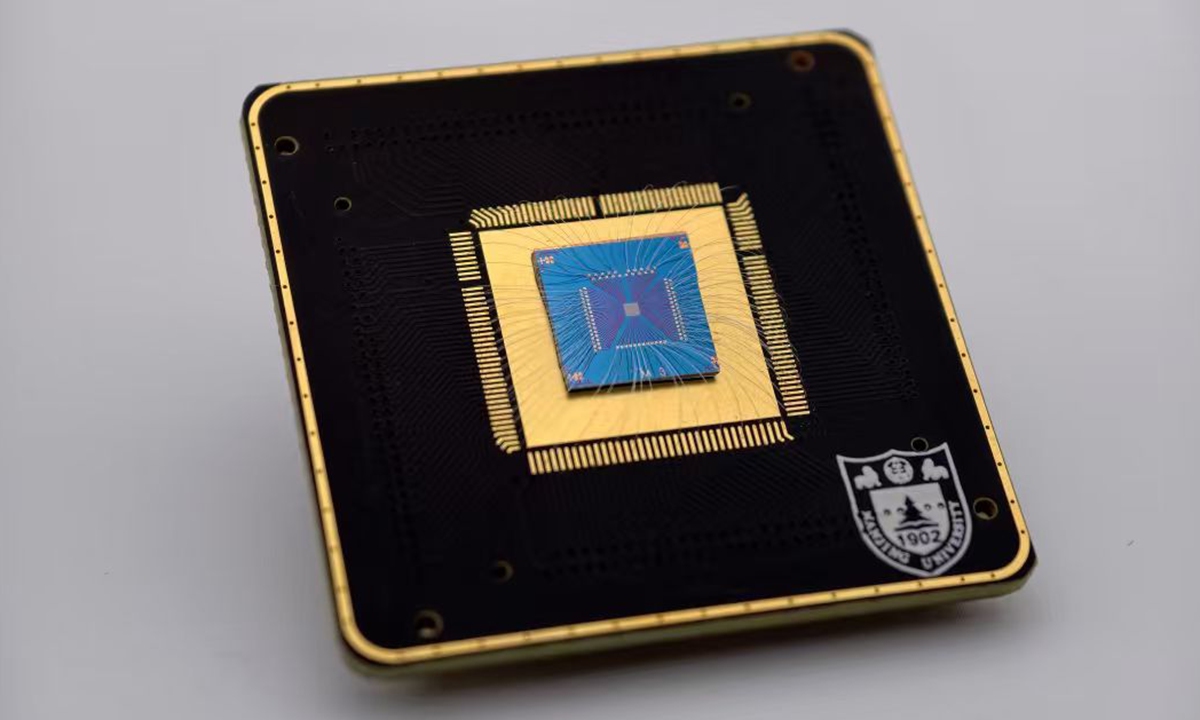
The new ultra-low-power intelligent vision sensor chip "LightTok" developed by a research team from Nanjing University. Photo: from Science and Technology Daily
A Chinese research team from Nanjing University has developed a new ultra-low-power intelligent vision sensor chip, dubbed "LightTok," that can convert light signals into tokens within the sensor, significantly reducing the high energy consumption caused by frequent transfers of massive amounts of redundant data, the principal investigator told the Global Times.
According to a release from the Institute of Brain-Inspired Intelligence of Nanjing University, tokens generated by the LightTok chip can be directly fed into a Transformer encoder for image recognition.
"Our design idea was to move token generation onto the sensor itself, allowing the chip to directly produce tokens that AI models can process once light reaches the sensor," Miao Feng, director of the Institute of Brain-Inspired Intelligence at Nanjing University, told the Global Times on Thursday. "These tokens contain complete image information."
Physical AI refers to intelligent systems capable of autonomously perceiving, reasoning, acting and receiving feedback in the real world, representing a key pathway for AI to move from the digital realm into the physical world. Vision-based physical AI systems powered by large AI models need to convert visual information from real-world environments into tokens that can be processed by AI models before feeding these tokens into Transformers for subsequent tasks.
In traditional visual perception pipelines, light signals must go through multiple stages, including image sensing, analog-to-digital conversion, data buffering and transfer, digital image patching and embedding, before being transformed into tokens that AI models can process. The frequent transfer of massive amounts of redundant data has resulted in high energy consumption at the edge, according to a report by Science and Technology Daily.
The LightTok chip directly addresses a key challenge in physical AI hardware: how to efficiently acquire and tokenize visual information from the physical world with low energy consumption, Miao said.
The LightTok chip consists of a photosensitive memory array and peripheral circuits. The team built the array based on single-layer molybdenum disulfide (MoS₂) floating-gate phototransistors, with each pixel capable of sensing light, storing information and performing analog computing. By processing optical information directly within the chip, the device can convert captured visual signals into tokens for AI models, according to the research team.
The current LightTok prototype has a resolution of 32×32 pixels, or 1,024 photosensitive pixels, which is still smaller than that of smartphone cameras and industrial imaging systems. However, Miao said the technology is compatible with CMOS manufacturing processes and can be scaled up. With wafer-level growth of molybdenum disulfide materials, the chip could potentially achieve a scale comparable to existing imaging devices.
Miao said the chip also draws inspiration from the information-processing mechanism of human vision. Similar to how the retina extracts key visual information before transmitting it to the brain, the chip also aims to process visual information at an early stage.
The research was conducted in collaboration with another research team from the National University of Singapore. The findings were published on Wednesday in Nature Sensors, an internationally renowned journal in the field of sensing technology, according to the release.
Potential applications for LightTok include drone systems, autonomous remote sensing and small-scale embodied AI systems, Miao said. In these scenarios, devices need to continuously detect, understand and track targets, generating massive amounts of visual data. By reducing the energy required for visual processing, the technology could extend the operating time of drones, satellites and small robots with limited power supplies, the expert said.
。赛场上,南城、寮步、横沥等传统强队稳扎稳打,松山湖等新兴力量敢打敢拼,胡婷芳乒乓球俱乐部等基层队伍同样展现出不俗实力。最终,镇街组前三名由南城街道队、寮步队、横沥队摘得;公开组前三名花落南城乒协、胡婷芳乒乓球俱乐部、横沥二队。

B | 作为落实《东莞市推进体育强市建设实施意见》的重点群众性赛事,本次活动获得了体彩公益金的支持。长期以来,体彩公益金持续赋能基层体育设施建设与品牌赛事打造,为东莞构建“市—镇—社区”三级全民健身赛事体系提供了坚实的保障。从社区露天球台到市级专业赛场,体彩公益金让“家门口的赛事”成为常态,真正打通了社区业余爱好者通往市级赛场的通道,让“运动之城”的建设成果切实转化为群众的获得感与幸福感。
Current article:http://iyu0vej.dinggaxilianmaiyuejienianguai.shop/news/20260826_7162.html
Published on:02:51:35

 SAP黄陈宏:“新型中国企业”向全数据、全链接、全绿色方向发展
 Amitabh Bachchan Pens a Heartfelt Tribute for His Sholay Co-star Late Dharmendra
 Indian Railway News: अयोध्या-जनकपुर रेलमार्ग को लगेंगे पंख, दिल्ली में चर्चा
 耕地复垦让村民信心倍增
 Guangzhou hospital launches art and humanities healing center
 我市举办木材供应链需求对接会
查看所有0条评论>>